CORE COMPETENCE CONFERENCE ON CHALLENGES RELATED TO DISPUTES ARISING FROM CROSS-BORDER MARRIAGES & ISSUES RELATED TO CUSTODY & GUARDIANSHIP OF CHILDREN

CONCEPT NOTE
A multifaceted diverse socio-cultural religion based society, with statutorily enacted personal laws, comprising of 1.4 billion Indians cohabit in 29 States. For its 35.42 million Indian diaspora domiciled in over 200 countries, global family law issues often pose a huge dilemma for resolution by Family Courts in a back drop of outmoded codified domestic family laws. Regardless, all Indian Courts perform herculean exercises to adjudicate these issues for resolution.
Hindu marriages made in heaven, solemnised on earth and dissolved abroad is a challenging agenda needing resolution. Children split across borders find solace in “parens patriae” jurisdiction of superior Constitutional Courts in the best interest and welfare of children, which finds a unique definition in the Juvenile Justice Act to state it “as the fundamental basis for any decision to ensure the child’s basic rights, identity, social well-being and holistic physical, emotional and intellectual development.” For me, as a practitioner & Secretary of the International Child Relocation Committee of the International Academy of Family Lawyers (IAFL), this concept finds immense favour in the Indian jurisdiction to balance child rights.
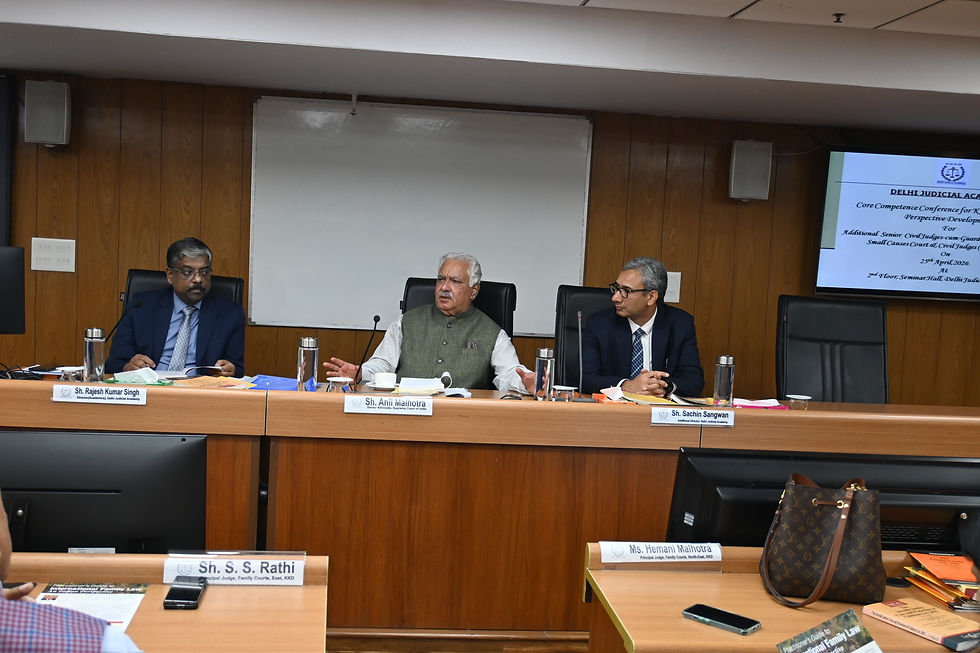
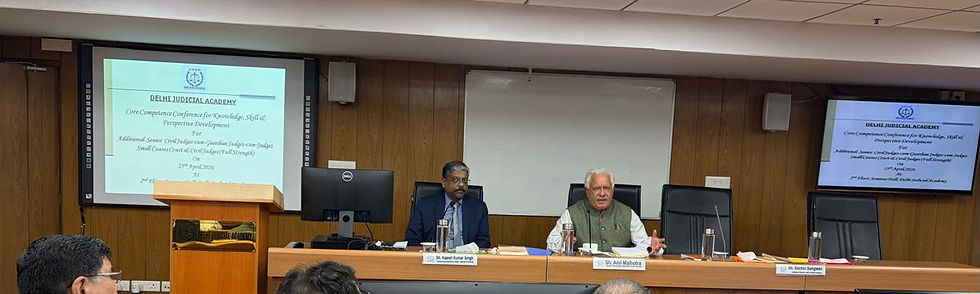
Invited to address a Full Court strength of Judges of Family Court was a rare opportunity for me to delve into legal intracacies of statutes enveloping human bonds. As a resource person, I was called upon to speak to the August Adjudicators. It was a teaching, learning and a dual enriching experience to share indepths of specialized Family Law jurisprudence. It was a two way street of interface and exchange of intellectual property in a unique programme with Principal and Additional Principal Judges of Family Courts at the Delhi Judicial Academy. This Core Competence Conference for Knowledge, Skill & Perspective Development, was an interactive three hour session on issues of crossborder Divorce, Custody and Guardianship of Children matters. It was a dialogue of an emerging Family Law Jurisprudence in crossborder relationships. Vibrant interpretations of Supreme Court and High Courts culling out possible remedies and reliefs formed the fulcrum of the debate.
Such vibrant discourses are an essential element for development of a holistic thought process to secure the ends of justice. This exercise is laudible for a realm of Indian perspectives of an International Family Law to mould, amalgamate and integrate legal intricacies of human relationships which need urgent repair, damage control and effective resolution. Gratitude owes to Mr. Rajesh Kumar Singh, Director (Academics) & Chairperson (Officiating), Delhi Judicial Academy for designing and implementing this innovative programme.
QUESTIONS ARISING IN CROSSBORDER ISSUES OF MARRIAGE AND DIVORCE.
1. Does a ceremonial marriage solemnised between a Hindu and a Non-Hindu under HMA (which is also registered under SMA) have any legal consequences in India? Is it a nullity? Is it necessisarily to be declared null and void? Does it need to be dissolved by a decree of divorce?
2. Does a marriage solemnised between a Hindu and a Non-Hindu entail legal consequences/claims for maintenance/alimony/matrimonial property?
3. Does overseas domicile, foreign nationality, permanent residence abroad displace jurisdiction of Family Courts in respect of parties of Hindu religion? Section 19 HMA is conclusive of jurisdiction. Place of marriage, residence of respondent in India at time of presentation of petition, if wife petitioner place where she residing on date of presentation of petition and place of residence of petitioner where respondent is not heard of for seven years is conclusive.
4. Overseas citizenship, foreign nationality, domicile abroad or residence overseas, does not displace jurisdiction of dissolution of Hindu marriage. Pending/concluded foreign divorce proceedings on grounds of irretrievable breakdown will nonsuit jurisdiction. Spouse in India can seek anti injunction suit proceedings before Family Court for restraining spouse. Maintenance, child custody property issues can be proceeded with under HMA as ancillary relief in a petition for divorce under Section 13 HMA.
5. What is the status in India of Foreign Divorce Decrees based on irretrievable breakdown of marriage obtained abroad ex-parte or by presence of both parties abroad & do they legally dissolve a Hindu Marriage?
6. In a subsequent divorce petition under HMA, if one Hindu spouse (of overseas domicile/foreign nationality), questions maintainability of the subsequent divorce petition on the ground of parties already being divorced abroad by irretrievable breakdown of marriage by an application under Order 7 Rule 11 CPC, can maintainability be adjudged as preliminary issue. Recognition of foreign divorce decrees/limping marriages (Rupak Rathi vs. Anita Chaudhary 2014(2)HLR (P&H) 96), (Satya vs. Teja Singh (1975) 1 SCC 120), (Y. Narasimha Rao vs. Y. Venkata Lakshmi (1991) 3 SCC 451).SSSS (Test of recognition of foreign judgement S. 13 CPC). Application of Order XIV Rule 2 (2) CPC (Preliminary issue on law question).
7. Can issues of alimony, maintenance, settlement of matrimonial property & custody of children under foreign divorce decrees (which do not satisfy the test of conclusivity under Section 13 CPC) be enforced perse?
8. If parties agree to settle matrimonial issues of divorce, maintenance, alimony, child custody (already decided by a foreign divorce decree), what is the best method of conclusively dissolving the Hindu Marriage and settling all ancilliary issues in India (besides putting an end to issues of Domestic Violence, Dowry, maintenance of 125 Cr.PC, FIRs for matrimonial cruelty ?
9. How can a Family Court conclusively settle a matrimonial dispute before it for putting an end to the Hindu Marriage of the Parties if execution of a foreign divorce decree is sought before it and what measures can be taken?
10. How can the Family Court facilitate appearance of parties online/by VC for dissolving marriages by mutual consent at the first/second motion ?
11. What is the procedure for recording evidence of parties in matrimonial proceedings if they are resident abroad and seek to depose from foreign jurisdiction as per rules of the High Court. Judgement: Sanjay Vs. Shikha (2023 -P&H):Mode for deposing for parties deposing & recording evidence.
12. Does an anti injunction suit lie before a Family Court under Section 7(1) Explanation (d) which prescribes suits of proceedings for “injunctions”? Can a Family Court restrain a party before it in a matrimonial proceeding abroad on principle of forum conveins if same issue between same parties is before it
13. What are the requirements of pleadings/ affidavits/ Vakalatnamas signed/ executed abroad &presented before a Family Court in India. Must be signed, notarised and apostilled abroad as per the Hague Apostile Convention ,1961, ie Convention for Abolishing requirements of Legalisation for foreign public documents. Pleadings must be verified abroad as per Order VI Rule 15 CPC and if not can they be struk off by Order VI Rule 16?
14. Does Electronic evidence ( emails/ recordings/ chats) as depositions abroad require to be supported by Affidavits deposed abroad under Section 65B of The Evidence Act and how can they be read as evidence in India?
15. For service of summons provisions of Order V Rule 9 (by Court), Rule 9(3) (by Email), 9A (Dasti) Rule 20 Substituted Service, Rule 25 Service Abroad by fax/email/High Court Rules and by whatsapp can be permitted additionally. If parties are represented by Counsel in other proceedings, parties can be served additionally by Counsel representing them.
16. For execution of monetary claims Family Court can follow procedure of Order XXI CPC: Under Section 18(1), a Family Court decree has the same force as a decree of a Civil Court. It is executed following the procedure laid down in Order XXI of the Code of Civil Procedure (CPC). Attachment of property and civil imprisionment can be ordered. Under Section 18(3), a Family Court can send a decree for execution directly to another Family Court or a Civil Court within whose jurisdiction the property or person is located. Unless there is a stay under Section 19 in appeal to the High Court, judgement is executable. Violation of child custody orders, contempt proceedings can be initiated.
17. Even though Under Section 46 CPC, a precept can be issued to a decree holder to execute a decree in a Foreign Court and it is upto the Foreign Court to accept or decline. Alternatively a fresh claim may have to be made in a Foreign Court. Practical experience shows monetary claims difficult to execute abroad. Best method is to attach property (moveable/immoveable) of judgement debtor in India.
QUESTIONS ARISING IN CROSSBORDER ISSUES OF CUSTODY & GUARDIANSHIP OF CHILDREN.
1. Can a Family Court entertain a petition for Guardianship and custody under the GWA if a minor is not ordinarily residing within its territorial jurisdiction? What is the interpretation of Section 9 GWA of words minor ordinarily residing.
2. Does the residence of the mother determine the residence of the minor for the purposes of jurisdiction under Section 9 GWA?
3. Does the interpretation of Section 6 HMGA determine jurisdiction of residence of minor under GWA when minor is ordinarily residing with a parent?
Ruchi Majoo v. Sanjeev Majoo AIR 2011 SC 1952,
JK v. NS 2019 SCC Online Del 9085,
Philip David Dexter v. State NCT of Delhi 2013(3) DMC 45
Harihar Pershad Jaiswal v. Suresh Jaiswal AIR 1978 AP 13
Harshadbhai Desai v. Bhavnaben Harshadbhai Desai AIR 2003 Guj 74
Sulbhi vs. Bhavesh Kumar 2025(2) HLR 129 following Rajesh vs. Komal FAO No. 2294/2024 decided by DB (P&H) on 27.08.2024.
4. What is the procedure to be followed in the adjudication of a Guardianship petition under the GWA by the Family Court?
Judgement of SC Aman Lohia vs. Kiran Lohia 2021 (5) SCC 489
5. Determination of best interest and welfare to be paramount consideration. Superior earning capacity, gender preference, age/sex/considerations.
Child centric jurisprudence.
6. Parental alienation syndrome considerations.
Supreme Court Judgement in Vivek Singh vs. Romani Singh 2017
7. Shared custody and joint parenting propositions.
Yashita Sahu vs. State of Rajasthan AIR 2020 SC 577
Savitha vs. Rajiv AIR 2020 (4) Karnataka 372
Tushar Ubale vs. Archana AIR 2016 Bombay 88
Aditi Bakht vs. Abhishek Delhi High Court.
Tejaswini Gaud 2019 (7) SCC 42
Lahari Sakhamuri 2019 (7) SCC 311
Vasudha Sethi 2022 ALL SCR (Crl.) 279
Vivek Singh 2017 (3) SCC 231
Rajeshwari SC-WP(Crl.) 402 of 2021 decided on 14.07.2022
Rohith 2022 SCC online SC 937.
Jasmeet Kaur 2020 (13) SCC 782.
Rani George WP (Crl.) 1206 of 2022 decided on 14.12.2023 Kerala High Court.





Comments